

KLI Colloquia are invited research talks of about an hour followed by 30 min discussion. The talks are held in English, open to the public, and offered in hybrid format.
Join via Zoom:
https://us02web.zoom.us/j/5881861923?omn=85945744831
Meeting ID: 588 186 1923
Fall-Winter 2026/27 KLI Colloquium Series
1 October 2026 (Thurs) 3-4:30 PM CET 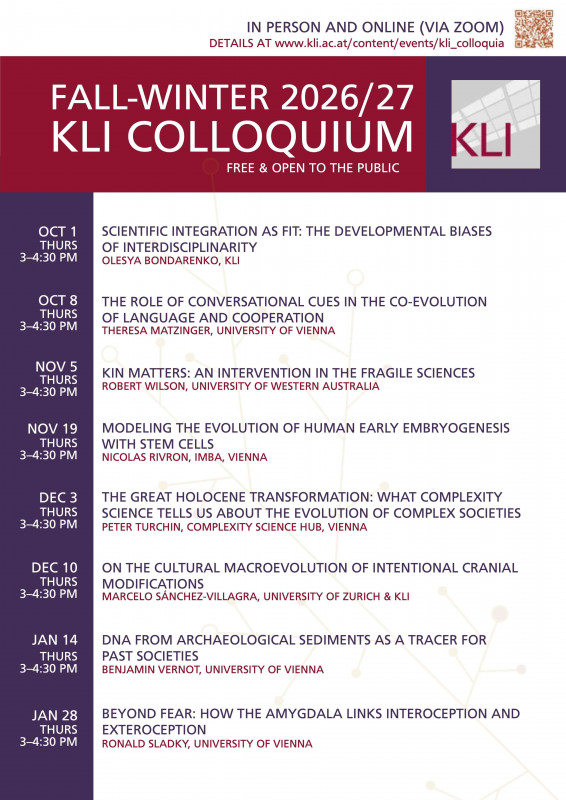
Scientific Integration as Fit: The Developmental Biases of Interdisciplinarity
Olesya BONDARENKO (KLI)
8 October 2026 (Thurs) 3-4:30 PM CET
The Role of Conversational Cues in the Co-Evolution of Language and Cooperation
Theresa MATZINGER (University of Vienna)
5 November 2026 (Thurs) 3-4:30 PM CET
Kin Matters: An Intervention in the Fragile Sciences
Robert A. WILSON (University of Western Australia)
19 November 2026 (Thurs) 3-4:30 PM CET
Modeling the Evolution of Human Early Embryogenesis with Stem Cells
Nicolas RIVRON (Institute of Molecular Biotechnology/IMBA, Vienna)
3 December 2026 (Thurs) 3-4:30 PM CET
Peter TURCHIN (Complexity Science Hub, Vienna)
10 December 2026 (Thurs) 3-4:30 PM CET
On the Cultural Macroevolution of Intentional Cranial Modifications
Marcelo SÁNCHEZ-VILLAGRA (University of Zurich)
14 January 2027 (Thurs) 3-4:30 PM CET
DNA from Archaeological Sediments as a Tracer for Past Societies
Benjamin VERNOT (University of Vienna)
28 January 2027 (Thurs) 3-4:30 PM CET
Beyond Fear: How the Amygdala Links Interoception and Exteroception
Ronald SLADKY (University of Vienna)
KLI Colloquia 2014 – 2026
Event Details
Join via Zoom:
https://us02web.zoom.us/j/5881861923?omn=85945744831
Meeting ID: 588 186 1923
Topic description / abstract
Language and cooperation are closely intertwined aspects of human social interaction, with language providing important cues for evaluating potential cooperation partners. In particular, subtle conversational features that are difficult to deliberately control or fake, such as speech pauses and linguistic alignment, may reveal information about others’ cognitive abilities, intentions, and cooperative tendencies. Understanding how people use these communicative cues to assess others can provide insights into the mechanisms underlying the evolution of both language and cooperation.
In this talk, I will present experimental evidence that long inter-turn speech pauses generally reduce perceived cooperativeness, but that listeners may tolerate longer pauses depending on the speaker and the conversational context. For example, listeners may tolerate longer pauses in non-native speakers because they recognize the cognitive demands involved in speaking a non-native language. Drawing on cross-cultural data, I will further show that pauses can function as reliable, difficult-to-fake cues of cooperativeness, even when listeners do not understand the language being spoken. Additionally, I show that people are more likely to choose others as cooperation partners when they use a grammatically similar way of expressing themselves.
Finally, I will discuss how this line of research can be extended beyond humans. Drawing on planned work with budgerigars, a highly vocal and socially interactive species, I will outline how comparative studies of conversational timing, turn-taking, and alignment may help to identify which mechanisms of conversation are uniquely human and which reflect evolutionary precursors of communication and cooperation.
Biographical note
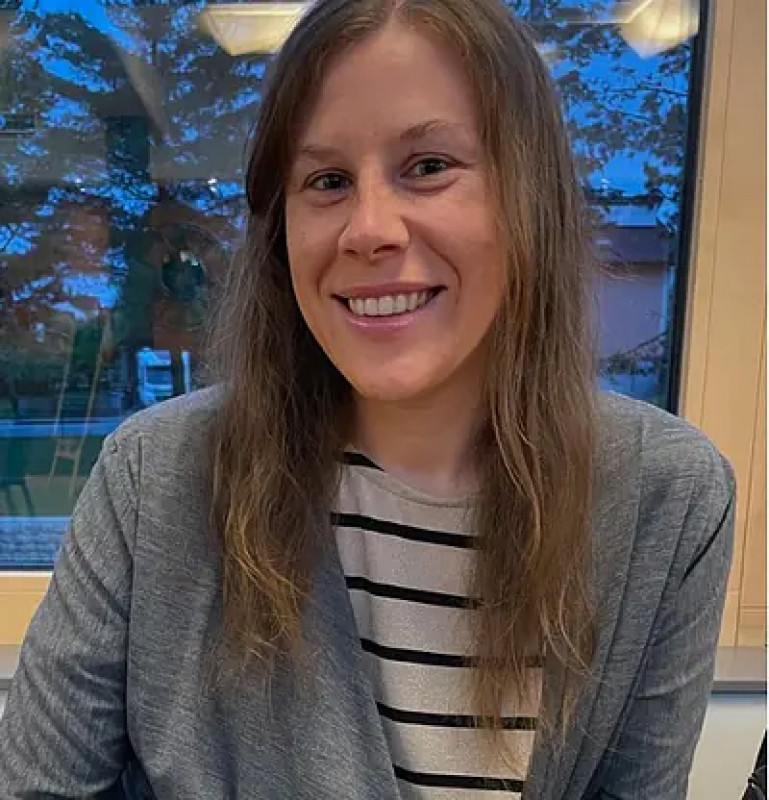
Theresa Matzinger is an interdisciplinary researcher interested in cognition, language, behavior and biology. After completing her PhD at the Department of Cognitive Biology at the University of Vienna, and a post-doctoral stay at the Centre of Language Evolution Studies at the University of Torun, she currently works as a post-doctoral researcher at the Department of English at the University of Vienna.
Theresa's main research goal is to shed light on the cognitive constraints and communicative pressures that led to similarities and differences between languages. Her work focuses on the biological and cultural evolution of language(s), language learning, historical language change, and non-human animal communication and cognition. Presently, she is extending her research to social and aesthetic factors that may influence how languages are acquired and used. In her research, she combines methods from the fields of psycholinguistics, evolutionary linguistics, historical linguistics, corpus linguistics, sociolinguistics, behavioral economics, and behavioral biology.
